Patrick: The Saint of Legend
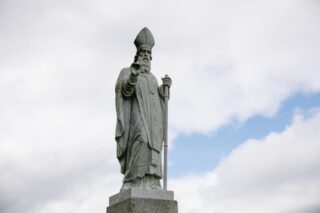
Patrick, whose real name is believed to be Maewyn Succat, was born in Roman Britain. At the age of sixteen he was enslaved for six years in Ireland, captured by the forces of the High King, Niall of the Nine Hostages. Patrick eventually escaped, and returned home to his family, only for him to have a vision that prompted his return to Ireland to spread Christianity to the Pagan population. He trained in Europe, and returned to Ireland as a bishop, ready to convert the people of Ireland.
As a Patron Saint of Ireland Patrick is known and celebrated all over the world on March 17. While he is credited with bringing Christianity to Ireland, there is so much more to his story. Saint Patrick is a multi-faceted figure who, much like Brigit, who is also a Patron Saint, straddles between the Christianised Ireland and its Pagan Mythology.
Upon arriving back in Ireland, Patrick went to Tara, the seat of the High King Laoghaire, son of Niall of the Nine Hostages. It was here that Patrick celebrated Easter on the same day as Beltaine, the summer festival associated with Celtic Pagan tradition. Beltaine was often marked with the lighting of a fire, an honour that fell to the chief druid, who would light the first fire on the Hill of Tara. However, Patrick beat them to it, lighting the paschal fire of Easter on the Hill of Slane, enraging the High King of Tara at his disrespect at tradition, despite the fact that his marking of the Christian festival was exactly the same as that of the Pagan festival. Laoghaire passed a sentence of death on Patrick, who, instead of fearing his punishment, scolded the High King for his Pagan worshipping. Though Patrick was unable to convert Laoghaire (according to some sources), he did walk away with his life and manage to convert many within the High King’s court.
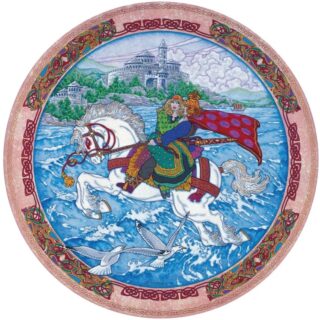
Laoghaire was not the only person Patrick did not manage to convert to Christianity. Within Irish mythology, there is a story of a conversation held between Patrick and Oisín of Tír na nÓg known as “The Arguments”. Upon returning from Tír na nÓg, Oisín finds Ireland much changed. After falling from his horse and becoming an old man, Oisín is taken in by Patrick. Oisín regales him with stories of Fionn MacCumhaill and the Fianna, but feels lost and alone without them now. While Patrick tells Oisín about Heaven and his God, Oisín refuses to convert and argues that the Pagan ways are still better and more noble.
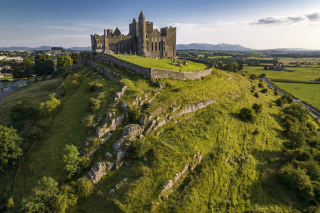
Patrick did manage to convert the King of Munster, Angus Mac Natfráich, at the Rock of Cashel, who did not cry out upon being accidentally punctured in the foot by Patrick’s crozier. Apparently, Angus thought it was part of the baptism process.
Likely the most well-known story associated with Patrick is of him banishing the snakes from Ireland. This famous story is often viewed as his success at driving Paganism out of Ireland, and yet it is entrenched in Irish Paganism. According to myth, it is said that Patrick was the one to banish the great snake-monster, Caoránach; while other versions claim he killed her in Lough Derg, turning the water red with her blood, hence the name (Derg/Dearg = red).
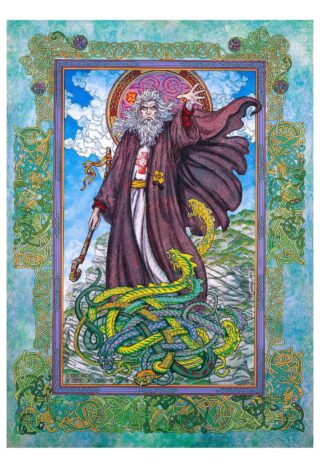
Patrick is said to have been looked after by Brigit in his final days, and buried in Downpatrick, where Brigit was buried when she died. Ireland’s third patron saint, Columcille, is also said to be buried alongside them.
“In Down, three saints one grave do fill: Patrick, Brigid and Columcille”.
Saint Patrick has a long-lived legacy within Ireland, both within history and mythology, so it is no surprise that many of his stories have reached legendary status.
Sources:
Gregory, Augusta. Gods and Fighting Men, 1904.
Heaney, Marie. Over Nine Waves: A Book of Irish Legends, 1995.
Mackillop, James. A Dictionary of Celtic Mythology, 2004.
Women involved in Custom House history
At the Custom House Visitor Centre, we commemorate the history of the building and its relevance to contemporary Ireland. This history can be male-centric. Women’s history, as it is labelled, is often omitted from the greater, accepted narrative of Ireland. This is a symptom of a much larger issue. To help address this issue, we have researched some of the women who have contributed to the history of our building and of Ireland. This research has since been turned into a specialised tour which we can now offer to visiting groups.
Born 1858, Beatrice Webb was a social reformer, feminist, and historian. She produced a nine-volume history of English Local Government. She served as commissioner for the Royal Commission on the Poor Laws. In 1908, she attended a hearing at the Custom House, before which she toured the workhouses and met a deputation, from the Irish Workhouse Association and the Irish Women’s Suffrage and Local Government Association. Under their influence, Webb questioned an inspector of the Local Government Board at the hearing. The inspector claimed that female representation in Local Government was satisfactory. Suffice to say, the issue of female local representation was deemed unimportant and did not figure in the subsequent report.
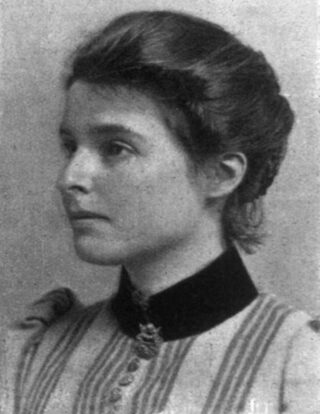
Ann ‘Nancy’ Wyse Power was born in 1889, to her politically active mother Jennie. She joined the Gaelic League in 1901. She graduated in 1912 from UCD with a First-Class Honours BA in Celtic Studies.
She became a member of Cumann na mBan in 1915, and took an active part in the Rising, joining the GPO garrison. From 1917, she was one of Cumann na mBan’s two honorary secretaries, and was instrumental to its post-Rising revitalisation – by 1920, the Cumann numbered 500 branches and 20,000 members.
Pre 1922, she was recruited to Dáil Éireann’s Foreign Service, and travelled to Berlin to set up an office to promote Irish interests. In 1923 she joined the Department of Industry and Commerce. In 1932, she became Seán T. O’Kelly’s private secretary in the Department of Local Government and Public Health. She went on to become principal officer in the civil service, becoming one of the first women to do so.
Nancy resented the inferior status of women within the Irish civil service, tracing such back to the British civil service. She argued, to the Brennan Commission, that women were kept from their male counterparts, thus limiting their prospects. It is worth mentioning that Nancy was never married and that if she was the marriage bar would have drastically limited her career options and greatly reduced her achievements.
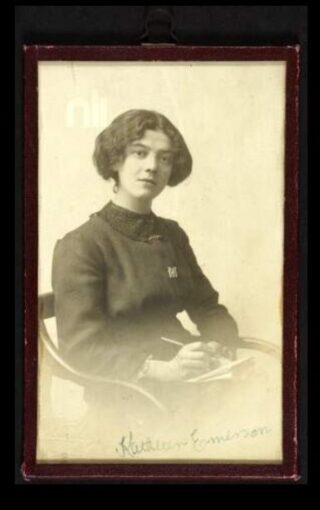
In 1912, Kathleen ‘Kay’ Emerson attacked the Custom House, smashing its windows. Emerson was a campaigner for women’s suffrage, and found herself aggravated by the rejection of the Snowden Amendment to the Home Rule Bill, which could have provided such. In the court proceedings regarding the act, Emerson said that she broke the windows because she would be ashamed not to, and that nothing short of a bomb would adequately express her feelings. As consequence, and her refusal to pay a fine, she was imprisoned in Mountjoy. She went on hunger strike, only to be released when her fine was paid anonymously.
On marrying, Emerson gave up her revolutionary ways. However, she was soon reactivated and took part in the broader movement against de Valera’s 1937 constitutional provisions on the status of women.
In 1932, Eileen Desmond was born to a fisherman and a seamstress. She was educated at the Convent of Mercy and was one of two girls in her class to sit her leaving certificate.
Aged seventeen, she took her first role in the civil service, as part of the Department of Posts and Telegraphs. In 1955, she married Labour TD Daniel Desmond. Due to the marriage bar in the civil service, Eileen had to give up her job, which led her to take up work assisting her husband.
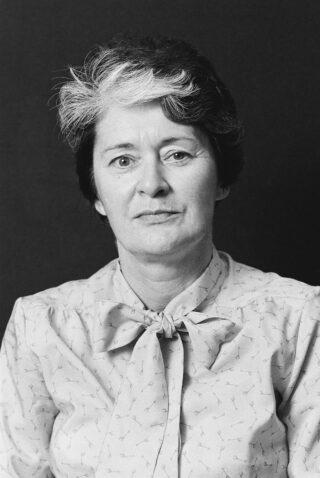
In 1965 she successfully competed in a by-election for a seat vacated by her deceased husband, and succeeded him on Cork County Council. She was the second female Labour TD, and one of the youngest members of the seventeenth Dáil Éireann and one of only five women elected. She ran unsuccessfully for the nineteenth Dáil, with some concluding that she lost her seat because of a ‘militantly feminist’ speech she gave on television. Eileen contested this, positing that her loss was due to the re-drawing of constituency boundaries. She was re-elected to the twentieth and twenty-first Dáilí, and, in 1979, to the European Parliament.
From 1981 to 1982, she was Minister for Health and Social Welfare of the twenty-second Dáil, making her the first woman to attain a senior cabinet position.
We have barely scratched the surface when it comes to the ‘women’s history’ of Ireland, and so there is still a significant amount of work to be done. Perhaps we might inspire others to action and the uncovering of figures and facts that have been neglected up to this point. At the very least, we aim to update our display to permanently feature the stories of these women and affirm their place in history.