Unspeakable History
At his trial for criminal indecency in 1895, the Irish writer Oscar Wilde was asked to define what was meant by the phrase ‘the love that dare not speak its name’. The quote was from a sonnet entitled ‘Two Loves’ which was written by his lover, Lord Alfred Douglas. By asking him to translate this poetic allusion into a factual prose definition, the prosecution were seeking to lure Wilde into self-incrimination. Wilde’s attempts to articulate and defend the way he lived and loved during his cross-examination ultimately contributed to his guilty verdict and a sentence of two years hard labour.
To speak frankly and openly about being homosexual was a dangerous thing in this part of the world up until relatively recently. For most people in the past who we might now see as being LGBTQ+, silence offered safety. They deliberately did not keep a record of their desires, their relationships or the nature of their love. What does survive of LGBTQ+ lives is coded and deliberately obscured. Very often the papers of LGBTQ+ figures were rigorously culled or completely destroyed after their death, either at their own request or by family members anxious to protect their reputation. It is also likely that some people who felt attraction to members of their own sex may not have been able to identify others who shared their feelings, or were not able to express what they felt even if they did suspect they had found a kindred spirit.
Reconstructing LGBTQ+ lives from the past often feels like making a jigsaw when most of the pieces are missing. We are forced to fill the blanks through considered speculation, creating narratives which are always provisional because we often lack the evidence to be definitive about a figure’s LGBTQ+ identity.
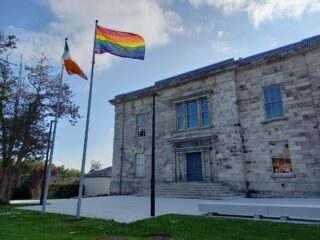
Wilde’s trial highlights the fact that in order to prosecute people for same-sex activities, it was necessary to name them. In contrast with other realms of life, the legal and penal system often offers rare examples of documented and verified evidence of LGBTQ+ lives. As a place where a significant number of men were imprisoned and punished for their sexual relations with other men, Kilmainham Gaol has a very important place in Ireland’s LGBTQ+ history. It was for that reason that in 2018, the museum first began running special queer history tours in order to share these stories. These tours now run every year, often to coincide with Pride or in response to specific requests from the Irish LGBTQ+ community.
While the prison registers record many men who were held in Kilmainham Gaol as a result of same-sex relations, the newspaper reports and other documentary evidence which might flesh out these stories is usually absent. The ‘unspeakable’ nature of these crimes meant that they were often not considered fit to be published. The exception to this was The Dublin Castle Scandals of 1884. In that year, the ‘United Ireland’ newspaper published stories revealing that male members of the British administration in Ireland had been engaging in homosexual activities. The paper was edited by William O’Brien M.P., a member of the Irish Parliamentary Party led by Charles Stewart Parnell. Parnell had bought the paper to be a mouthpiece for the party and these articles were part of a wider battle between the Irish nationalist movement and the British government at the time.
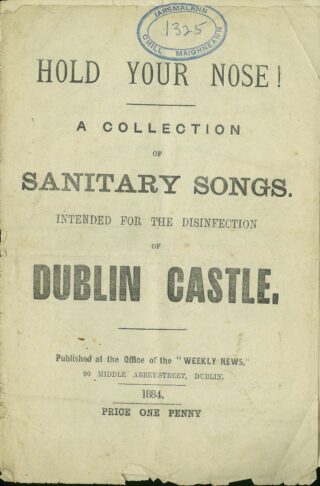
The initial targets of these revelations were James Ellis French, the Director of Detectives of the Royal Irish Constabulary (RIC), and Gustavus Cornwall, the Secretary of the General Post Office. Cornwall sued William O’Brien for libel and lost, leading to the criminal prosecution of French, Cornwall and six other men. All eight were held in Kilmainham during their criminal trial.
While the focus of the prosecution was to find evidence of sexual activity between the men, the trials inadvertently gave a brief glimpse into what appears to have been quite a vibrant, albeit hidden, gay subculture in Dublin in the late 19th century. Although one of the newspaper headlines described them as ‘Unspeakable Crimes’, the Irish press often covered the court proceedings in great detail, although on occasion they would state that certain aspects of the evidence was too obscene for publication. Despite this, stories emerged of sexual encounters in numerous places such as the Botanic Gardens in Glasnevin, the urinals bellow the Thomas Moore statue, and the back lanes behind the Queen’s Theatre on Great Brunswick Street. Less salacious details also emerged such as musical evenings in each other’s homes, trips to concerts and nights at the theatre. So significant were musical events in the lives of some of the men that for years afterwards in Dublin describing a man as ‘musical’ became a euphemism for gay.
The men implicated in the trial came from all classes and walks of life. In addition to upper middle-class government officials like French and Cornwall, there were army officers, office clerks, working class men and ordinary soldiers. These men would sometimes meet in tenement rooms in Great Ship Street and Golden Lane in what the prosecution described as as male brothels. Daniel Considine rented the rooms on Great Ship Street and was described as a blind former schoolteacher who supported himself as a basket maker. When giving his evidence he mentioned that he had, in his youth, performed as a female impersonator on the stage and for private parties attended by the Lord Lieutenant in Dublin Castle. James Pillar, a Quaker grocer and wine merchant, allowed one of the backrooms in his shop on Rathmines Road to be used for assignations which became known as either Pillar’s Bower or Evelina’s Bower.
Some of the most fascinating details came from the testimony of Malcolm Johnston, the son of a wealthy Dublin businessman, who seems to have been coerced into testifying against his former friends. On one occasion he described a ball he held in his family home on Clyde Road in Ballsbridge when his father was out of town. All the guests were men, and Johnston and many of the men wore female attire. Among those who attended were two clergymen, one Catholic and one Church of Ireland. Johnston also testified about the nicknames the men adopted, most of which were female. Cornwall was known as ‘The Duchess’, another man, George Taylor, was ’The Maid of Athens’ while Pillar was referred to as ‘Pa’. Johnston himself was referred to as ‘Lady Constance Clyde’ or just ‘Connie’.
Were it not for these trials, which had catastrophic consequences for the lives of the majority of the men drawn into the scandal, we may well have known nothing about the extent of gay life in Dublin in the 1880s. In contrast, we don’t know whether a similar scene existed in previous decades, nor do we know what kind of chilling effect the exposure of the 1884 trials had on the gay scene in Dublin in the years that followed.
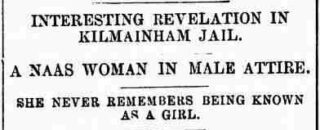
Prisons are places where secrets were often laid bare and in 1889 an article in the ‘Kildare Observer’ describes how John Bradley, a young man aged 25, was arrested and imprisoned in Kilmainham Gaol for 14 days on charges of vagrancy. He was born in Naas but grew up in New Row, just off Francis Street in the Liberties where he attended the Christian Brother’s School for Boys. His father died when he was very young and his mother supported them both as a laundress. She died a few weeks prior to his arrest and John seems to have been at a loss when it came to supporting himself which led to him being arrested for vagrancy. Kilmainham was an all-male prison at that time. When John was ordered to go for a bath he resisted, and following a heated discussion with the warders, the “poor creature with tears in her eyes pleaded that she was a woman” and had actually been born Jane Bradley. They never remember being referred to as anything other than John Bradley and had never been dressed or referred to as a girl. The prisoner, now called Jane Bradley, was transferred to Grangegorman Women’s Prison. Like so many of the criminal prisoners, we don’t know what happened to John/Jane after this, or what gender they subsequently identified with. The article concluded with the sentence “On being received into Grangegorman Jail, the prisoner was dressed in women’s clothes, which she seemed to feel very awkward and uncomfortable in.” Interestingly, in a handwritten memoir recently donated to Kilmainham Gaol Museum, a former prison guard who worked in Kilmainham and other prisons record a similar case when he was based in Dundalk Prison. With so little information it is impossible to know what the true story of John/Jane Bradley was. While it is certainly an interesting example of gender non-conformity, and one could speculate that John/Jane Bradley may have been what would now be described as transgender, it is impossible to be definitive.
The criminalisation of sexual relations between men in the past gave a degree of visibility to gay men’s lives which was almost entirely absent for lesbian and bisexual women. A number of the women associated with the struggle for Irish independence who were imprisoned in Kilmainham in the 20th century lived in partnerships with other women. The exact nature of these relationships is unknown. In 20th century Ireland it was perfectly acceptable for two single women to share a home together and be essentially treated as a social unit. This was certainly the case for Margaret Skinnider, a primary school teacher from Coatbridge near Glasgow.
Skinnider’s parents were Irish and she became involved in the independence movement and joined the Irish Citizen Army. She fought in the 1916 Rising where she served as a sniper on the roof of the College of Surgeons. She was seriously wounded, but managed to make a full recovery. In 1917 she went to the United States where she lectured about her experiences during the Rising to raise money for the Republican cause. According to Skinnider’s biographer, Dr. Mary McAuliffe, it was there she met Tipperary-born Cumann na mBan member, Nora O’Keefe. The two women moved in together in 1919 and shared the rest of their lives until Nora’s death in 1962. Neither woman ever publicly identified as LGBTQ+, but it is clear that their relationship with one another was the most significant in their lives.
Both women took the Republican side during the Civil War and were imprisoned as a result, though it seems likely that they were never held in the same prison and the same time. In August 1923 Nora O’Keefe signed the autograph book of Jenny Coyle, a fellow prisoner in Kilmainham Gaol. Significantly, she found a page that Margaret had signed earlier that year when she and Jenny Coyle were prisoners together in Mountjoy Prison. Nora very deliberately squeezed in her own name beside it. It remains a small but significant record of their devotion to one another.
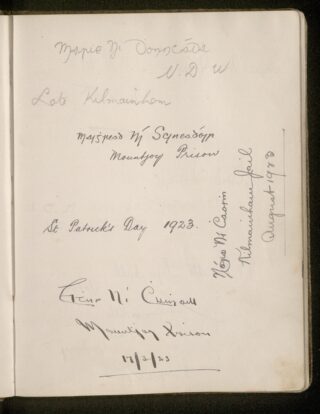
It is from fragments like Nora O’Keefe’s unusually placed signature that we can begin to recover LGBTQ+ lives from the past. The histories recounted here are just some of many LGBTQ+ stories that have come to light since Kilmainham Gaol first started running its queer history tours. While they may be just fragments, together they form a larger narrative and give a deeper insight into the secret queer lives of people from the past. LGBTQ+ people often struggled to survive in a time when society was deeply hostile to them and they faced terrible persecution because of their sexual identity. However, many of the stories which have emerged in relation to Kilmainham Gaol also feature periods of joy, resilience and love. Telling LGBTQ+ stories in Kilmainham Gaol, which were so long thought of as unspeakable, feels like an act of liberation and long overdue restitution.