
William Derham
Since 1938, when Ireland elected its first head of state, the Office of Public Works has had the responsibility for hosting the inauguration of Ireland’s presidents. The Upper Yard at Dublin Castle was initially suggested as a possible venue by Éamon de Valera, possibly with an eye to the inauguration of the U.S. president in front of the Capitol Building in Washington D.C., but he was persuaded that the Irish weather could not be depended upon and so it was moved inside to St Patrick’s Hall.
In the run up to the first inauguration, of Dr Douglas Hyde, on 25 June 1938, an OPW file records that:
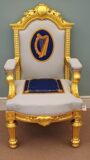
The principal accommodation on the Dais will be a gilt arm chair which the Chairman has directed to be covered in Blue Silk, and a suitable Table for An Uachtaran to sign at.
This might sound rather benign, but this was no regular armchair. It was in fact a repurposed throne, one of a pair made in the nineteenth century, bearing the royal monogram of “VR” and topped with an imperial crown (the other, similarly
repurposed, is used by the Cathaoirleach of Seanad Éireann). In addition to a new blue-silk covering, the throne had its crown and monogram removed. With such minor alterations, it was replaced
where it had stood in former times, on a dais at the end of St Patrick’s Hall to receive the nation’s head of state. But this was a very different head of state. The subtle contrast, to those who
noticed, must have been striking.
This ‘gilt arm chair’ was used in time by Éamon de Valera himself, and by each of Ireland’s presidents up until the inauguration ceremony of 2011. Coinciding with the Craft Council of Ireland’s ‘Year of Craft’ in 2011, and with thoughts that the old chair was worn out, a new chair was commissioned from the furniture maker John Lee.
Dublin Castle has recently had the older chair restored. It was re-gilded by Fergus Purdy, reupholstered by the OPW’s Furniture Branch, and its magnificent Irish embroideries of the state harp and four shamrocks conserved and re-applied by textile conservator Karen Horton. This ‘gilt arm chair’ is a remarkable example of the mixture of change and adaptation that accompanied Ireland’s independence. Much like our
post boxes with their occasional royal monograms, painted green after 1922, this chair embodies our entangled and contested history while reflecting our independence alongside a pragmatic
respect for the past.
On one of his many visits to Dublin Castle, in March 1952, De Valera’s own view on our island’s contested material
culture was noted down:
On the general question of the State Apartments […] the
aim should be to keep them in good condition. While some
people held the view that emblems of British rule should
be removed there was a case for preserving them for their
historical significance and for the emphasis which they
placed on the changeover to national independence. This
applied particularly to places like St. Patrick’s Hall and the
State Apartments generally where there is so much of
value and artistic merit as well as of historical significance.
For De Valera, this was all history – and it was much better to turn the pages of history than to tear them out. Such things would serve as reminders of the past, and memories of that past would serve as a contrast to a new, independent present.
These sentiments were echoed by President McAleese, during the speech she made on 18 May 2011 when hosting Queen Elizabeth II to a State banquet in St Patrick’s Hall:
The relationship between our two neighbouring nations is
long, complex and has often been turbulent. Like the tides that
surround each of us, we have shaped and altered each other. […]
Inevitably where there are the colonisers and the colonised, the
past is a repository of sources of bitter division. The harsh facts
cannot be altered nor loss nor grief erased but with time and
generosity, interpretations and perspectives can soften and open
up space for new accommodations.
As we think upon the long and complicated history of the properties in our care, it is worth interrogating the material culture of our past. For better or worse, it is a shared past, with shared, multiple histories. As President McAleese noted, we need to be alive to the possibilities of new interpretations and perspectives. It is curious to think that such interpretations were already being explored as far back as the 1930s, when Ireland consolidated its independence by electing its first head of state, and inaugurated that person on a crownless throne.