
Shauna Fox
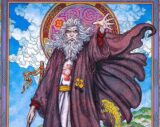
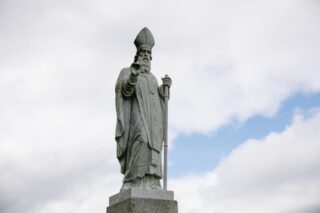
Patrick, whose real name is believed to be Maewyn Succat, was born in Roman Britain. At the age of sixteen he was enslaved for six years in Ireland, captured by the forces of the High King, Niall of the Nine Hostages. Patrick eventually escaped, and returned home to his family, only for him to have a vision that prompted his return to Ireland to spread Christianity to the Pagan population. He trained in Europe, and returned to Ireland as a bishop, ready to convert the people of Ireland.
As a Patron Saint of Ireland Patrick is known and celebrated all over the world on March 17. While he is credited with bringing Christianity to Ireland, there is so much more to his story. Saint Patrick is a multi-faceted figure who, much like Brigit, who is also a Patron Saint, straddles between the Christianised Ireland and its Pagan Mythology.
Upon arriving back in Ireland, Patrick went to Tara, the seat of the High King Laoghaire, son of Niall of the Nine Hostages. It was here that Patrick celebrated Easter on the same day as Beltaine, the summer festival associated with Celtic Pagan tradition. Beltaine was often marked with the lighting of a fire, an honour that fell to the chief druid, who would light the first fire on the Hill of Tara. However, Patrick beat them to it, lighting the paschal fire of Easter on the Hill of Slane, enraging the High King of Tara at his disrespect at tradition, despite the fact that his marking of the Christian festival was exactly the same as that of the Pagan festival. Laoghaire passed a sentence of death on Patrick, who, instead of fearing his punishment, scolded the High King for his Pagan worshipping. Though Patrick was unable to convert Laoghaire (according to some sources), he did walk away with his life and manage to convert many within the High King’s court.
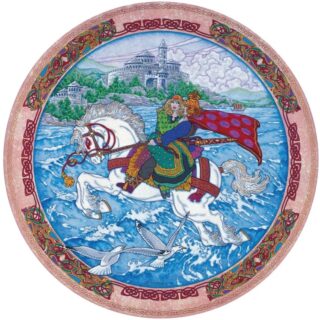
Laoghaire was not the only person Patrick did not manage to convert to Christianity. Within Irish mythology, there is a story of a conversation held between Patrick and Oisín of Tír na nÓg known as “The Arguments”. Upon returning from Tír na nÓg, Oisín finds Ireland much changed. After falling from his horse and becoming an old man, Oisín is taken in by Patrick. Oisín regales him with stories of Fionn MacCumhaill and the Fianna, but feels lost and alone without them now. While Patrick tells Oisín about Heaven and his God, Oisín refuses to convert and argues that the Pagan ways are still better and more noble.
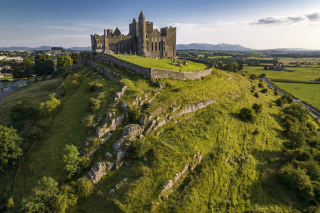
Patrick did manage to convert the King of Munster, Angus Mac Natfráich, at the Rock of Cashel, who did not cry out upon being accidentally punctured in the foot by Patrick’s crozier. Apparently, Angus thought it was part of the baptism process.
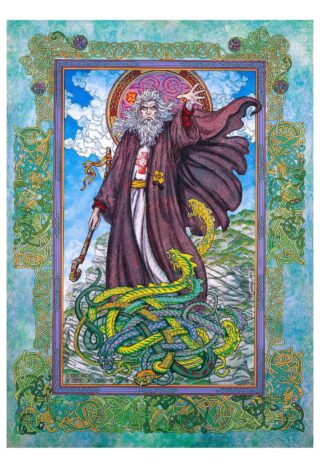
Likely the most well-known story associated with Patrick is of him banishing the snakes from Ireland. This famous story is often viewed as his success at driving Paganism out of Ireland, and yet it is entrenched in Irish Paganism. According to myth, it is said that Patrick was the one to banish the great snake-monster, Caoránach; while other versions claim he killed her in Lough Derg, turning the water red with her blood, hence the name (Derg/Dearg = red).
Patrick is said to have been looked after by Brigit in his final days, and buried in Downpatrick, where Brigit was buried when she died. Ireland’s third patron saint, Columcille, is also said to be buried alongside them.
“In Down, three saints one grave do fill: Patrick, Brigid and Columcille”.
Saint Patrick has a long-lived legacy within Ireland, both within history and mythology, so it is no surprise that many of his stories have reached legendary status.
Sources:
Gregory, Augusta. Gods and Fighting Men, 1904.
Heaney, Marie. Over Nine Waves: A Book of Irish Legends, 1995.
Mackillop, James. A Dictionary of Celtic Mythology, 2004.