Patrick: The Saint of Legend
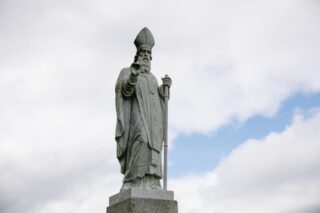
Patrick, whose real name is believed to be Maewyn Succat, was born in Roman Britain. At the age of sixteen he was enslaved for six years in Ireland, captured by the forces of the High King, Niall of the Nine Hostages. Patrick eventually escaped, and returned home to his family, only for him to have a vision that prompted his return to Ireland to spread Christianity to the Pagan population. He trained in Europe, and returned to Ireland as a bishop, ready to convert the people of Ireland.
As a Patron Saint of Ireland Patrick is known and celebrated all over the world on March 17. While he is credited with bringing Christianity to Ireland, there is so much more to his story. Saint Patrick is a multi-faceted figure who, much like Brigit, who is also a Patron Saint, straddles between the Christianised Ireland and its Pagan Mythology.
Upon arriving back in Ireland, Patrick went to Tara, the seat of the High King Laoghaire, son of Niall of the Nine Hostages. It was here that Patrick celebrated Easter on the same day as Beltaine, the summer festival associated with Celtic Pagan tradition. Beltaine was often marked with the lighting of a fire, an honour that fell to the chief druid, who would light the first fire on the Hill of Tara. However, Patrick beat them to it, lighting the paschal fire of Easter on the Hill of Slane, enraging the High King of Tara at his disrespect at tradition, despite the fact that his marking of the Christian festival was exactly the same as that of the Pagan festival. Laoghaire passed a sentence of death on Patrick, who, instead of fearing his punishment, scolded the High King for his Pagan worshipping. Though Patrick was unable to convert Laoghaire (according to some sources), he did walk away with his life and manage to convert many within the High King’s court.
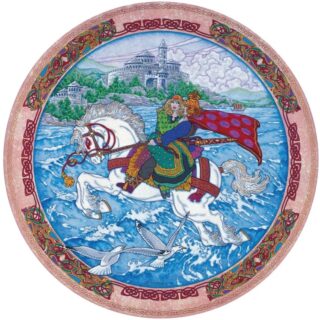
Laoghaire was not the only person Patrick did not manage to convert to Christianity. Within Irish mythology, there is a story of a conversation held between Patrick and Oisín of Tír na nÓg known as “The Arguments”. Upon returning from Tír na nÓg, Oisín finds Ireland much changed. After falling from his horse and becoming an old man, Oisín is taken in by Patrick. Oisín regales him with stories of Fionn MacCumhaill and the Fianna, but feels lost and alone without them now. While Patrick tells Oisín about Heaven and his God, Oisín refuses to convert and argues that the Pagan ways are still better and more noble.
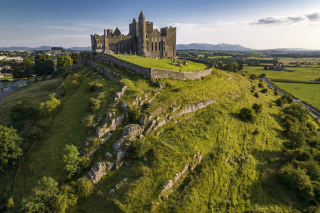
Patrick did manage to convert the King of Munster, Angus Mac Natfráich, at the Rock of Cashel, who did not cry out upon being accidentally punctured in the foot by Patrick’s crozier. Apparently, Angus thought it was part of the baptism process.
Likely the most well-known story associated with Patrick is of him banishing the snakes from Ireland. This famous story is often viewed as his success at driving Paganism out of Ireland, and yet it is entrenched in Irish Paganism. According to myth, it is said that Patrick was the one to banish the great snake-monster, Caoránach; while other versions claim he killed her in Lough Derg, turning the water red with her blood, hence the name (Derg/Dearg = red).
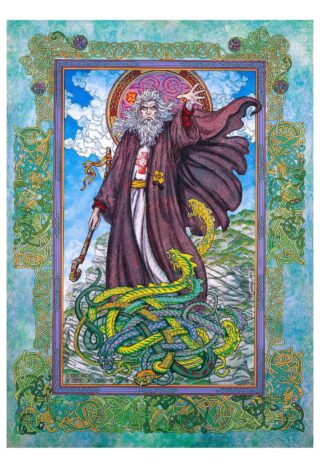
Patrick is said to have been looked after by Brigit in his final days, and buried in Downpatrick, where Brigit was buried when she died. Ireland’s third patron saint, Columcille, is also said to be buried alongside them.
“In Down, three saints one grave do fill: Patrick, Brigid and Columcille”.
Saint Patrick has a long-lived legacy within Ireland, both within history and mythology, so it is no surprise that many of his stories have reached legendary status.
Sources:
Gregory, Augusta. Gods and Fighting Men, 1904.
Heaney, Marie. Over Nine Waves: A Book of Irish Legends, 1995.
Mackillop, James. A Dictionary of Celtic Mythology, 2004.
Brigit: The Goddess and The Saint
If there is one figure in Irish lore that has risen from the ashes of obscurity in recent years, it is Brigit, a figure representing the duality of both Goddess and Saint. In the seasonal calendar, February 1st marks Imbolc, a pre-Christian festival that indicated the beginning of Spring and was often associated with Brigit, or Bríg, the Goddess of Fire. In the Christian calendar, the 1st marks the feast day of the Patron Saint Brigit, who is also associated with fire and protection. These dual figures are one and the same, a mirror image, with one emerging from the foundations of the other.
As the pre-Christian representation, the Goddess version of Brigit is the precursor to the Saint. Brigit was known as a triple goddess, connected with healing, smith-craft and poetry, and was known as the ‘Exalted One’. She was also one of three daughters of the Dagda, a god of the Tuatha Dé Danann – a powerful and magical people, who are later referred to as the Sídhe (faeries) when they retreat underground. Despite being a well-known figure today, especially through festivals held in Dublin and Louth, there is very little noted of Brigit within our mythology. Brigit is really only mentioned, briefly, during the story of the Second Battle of Moytura when she mourns the death of her son, Ruadán.
“And then Brigit came and keened her son with shrieking and with crying”
"Gods and Fighting Men" - Lady Augusta Gregory
This moment is significant as the first keening in Ireland. It could be argued that the Goddess was a predecessor to the Banshee, who is known to keen or wail when death is near.
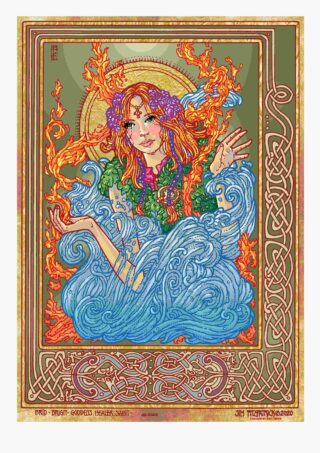
Brigit, the Saint, much like the Goddess, is often associated with three things: fertility, abundance and protection. She was born in the middle of the 5th century; she lived, as a child, with a druid, and drank the milk of Otherworld cows – even within the Christianised version of Brigit there are elements of mythology weaved through her story. Fire became a symbol associated with Brigit after a bishop came across her praying in a small church she had founded, with a fire appearing and growing around her and the building. Legend has it that twenty nuns (Brigit being one) would guard the fire that had continued to burn for 500 years, even after Brigit’s death. The Goddess’ connection to fire may seem more tenuous than that of the Saint, however the Goddess Brigit is said to represent fire’s transformative properties through her power of healing.
There are a number of symbols that evoke the memory of Saint Brigit, beyond that of fire, including the cross of rushes, and a cloak. It is said that Brigit fashioned a cross from rushes that were on the floor so that she could convert a man to Christianity on his deathbed.
As for the cloak, Brigit used this as a means of getting what she was promised by a King of Leinster. Brigit had founded a religious house in Kildare, and as her community grew she requested land from the king in order to build a monastery. He agreed, only to renege soon after. Frustrated at his constant stalling, Brigit finally asked him to at least let her have as much land as her cloak would cover. Laughing at the meagre size of her cloak, the king conceded. Four nuns then picked up the corners and proceeded to run the four directions of the compass, continuing to cover the land until the king begged Brigit to stop, and gave her what was promised.
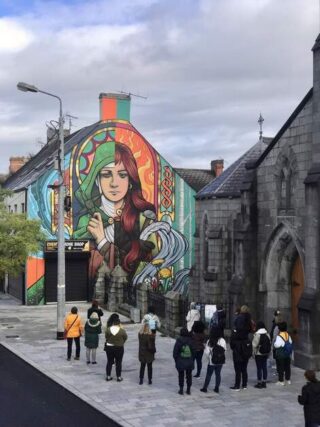
Today, there are many sites across Ireland that bear Saint Brigit’s name and evoke the stories that she is remembered for on February 1st. Two of these sites come under OPW care: Tully Church at the foot of the Dublin Mountains has Brigit as its Patron Saint; while Clare Island Abbey, off the coast of Mayo, is also officially known as St. Brigit’s Abbey. Meanwhile, Imbolc is affiliated with the Goddess Brigit, and is known as a cross-quarter day in which the sunlight reflects into the passage chambers of Cairn L at Loughcrew and the Mound of Hostages at the Hill of Tara.
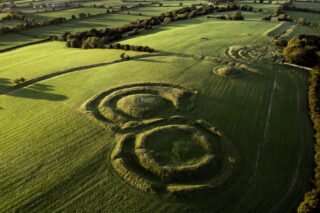
The original Pagan tales act as the core on which to build the story of the later Christian figures; the supernatural elements of the Patron Saint’s life hark back to her mythological doppelganger. Their associations with fire, their raising by druids, their remembrance on the same day all ties these two women together, despite their veneration by people of different beliefs. The blending of one’s story with the other led to the Goddess entering the shadows to pave the way for the Saint. Now the Saint and her stories are more widely known and celebrated than that of the Goddess – certainly within Irish myth. Yet, without the Goddess would the Saint exist?
Sources:
Brennan, Martin. The Stones of Time: Calendars, Sundials, and Stone Chambers of Ancient Ireland, 1994.
Britannica.com
Gregory, Augusta. Gods and Fighting Men, 1904.
Heaney, Marie. Over Nine Waves: A Book of Irish Legends, 1995.
Mackillop, James. A Dictionary of Celtic Mythology, 2004.
MacLeod, Sharon Paice. Celtic Myth and Religion: a study of traditional belief, with newly translated prayers, poems, and songs, 2012.
maps.arcgis.com – Historic Environment Viewer
Massey, Eithne. The Turning of the Year: Lore and Legends of the Irish Seasons, 2021.
Medb of Connaught
Queen. Warrior. Goddess. Medb of Connaught was many things within Celtic mythology.
As Queen, Medb ruled over the province of Connaught, overseeing her kingdom
from her seat of power at Rathcroghan.
As Warrior, Medb raised an army against Ulster to ensure she would gain possession of the Brown Bull of Cooley.
As Goddess, Medb represented fertility and sovereignty, offering men the power of kings through marriage.
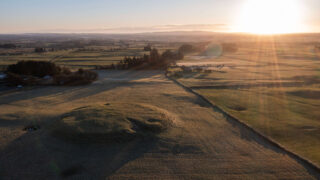
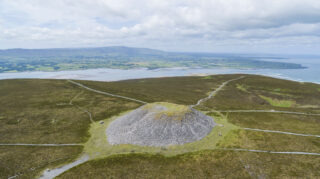
With the mounds of Rathcroghan, and the cairn at Knocknarea said to symbolise parts of Medb’s body, it signifies the legacy that she left within Irish pseudohistory - her powerful connection to the land that is written in the earth itself.
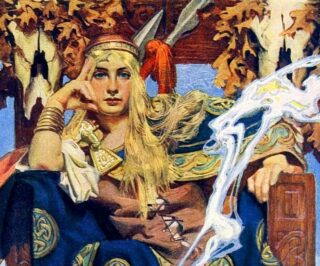
According to mythology, the epic battle known as the Táin Bó Cúailnge (Battle of Cooley) was incited during a seemingly innocuous conversation between Medb and her then husband/consort, Ailill Mac Máta. What started as a bed-time discussion turned into one of the most brutal fights in pseudohistory.
“In Ailill’s herd there was a magnificent bull called the White-horned and Medb had none to touch it.”
As comparisons are made between the couple over who has the greater fortune, the most prized possessions, they realise they are equal in all things…bar one. Where Ailill is in possession of Finnbennach, the great White-Horned bull (who was once owned by Medb), Medb has nothing to match.
Knowing that the only way to surpass Ailill’s fortune is to obtain the Brown Bull of Cúailnge, Medb rallies troops of men behind her from her seat at Rathcroghan, and goes to war against Ulster when the bull’s owner refuses to hand him over.
There are two ways of reading Medb’s actions here:
The first is to see her decision to go to war as juvenile and trivial, risking people’s lives for mere belongings, just to win a competition against her husband.
The second, however, provides us with a more nuanced depiction of Medb’s character, as Queen, but also as a woman. According to Sylvia Brinton Perera, Medb’s decision to go to war signifies a determination to maintain independence, to retain and protect her power over herself and her land, from what Perera calls “the rising patriarchal Celtic aristocracy.”
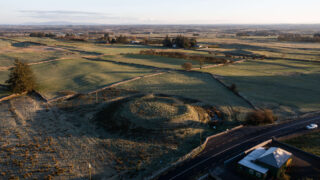
Ailill receives his power, his authority, via his marriage to Medb; without her, his rule is not legitimate, demonstrating the influence that Medb holds. As the recognised Sovereign of Connaught, her authority over the lands of Rathcroghan and its people is power that Medb does not want to lose. Her being is so tied to Rathcroghan that her bodily functions actually alter the landscape when her menstrual blood creates the earthwork channels known as the Mucklaghs.
The Táin Bó Cúailnge symbolises Medb’s fight to remain equal to her husband and retain the lands that are so much a part of herself.
“ I have never heard in all Ireland of a province run by a woman except this one.”
Ailill confirms the power that Medb has within Connaught with this statement, which is why only Medb can determine who becomes king through a sacred marriage ritual.
This ritual involved the chosen man becoming so drunk that it would grant him access to the spiritual world, thus receiving the knowledge required to rule a kingdom. The word mead has a close correlation with Medb’s name, meaning ‘drunken one’ or ‘she who makes drunk’.
Perera notes that in other folklore, as well as Celtic, the goddess of sovereignty is not only the one serving the drink, but is also the drink herself, therefore giving her future king the power and knowledge to rule alongside her divine self. Only those kings selected by Medb were recognised by the people.
However, if the king was no longer fulfilling his duty, both as ruler and husband to Medb, the failure would be reflected in the land. Land that Medb is visible in.
At Rathcroghan, its earthworks and mounds reflect Medb’s bodily fluids and her physical form.
At Tara, where Medb’s father was King, the henge Rath Maeve is named after her (which could also refer to her predecessor Medb Lethderg).
At Knocknarea, Queen Medb’s Cairn is a symbol of the life/death cycle, representative of pregnancy in its rounded shape among the mountains, while also being Medb’s supposed resting place.
According to Gerard Mulligan, parts of Rathcroghan may have been deliberately created to represent Medb, “allowing the king to be ‘physically’ close to the goddess” even when she is not there, always maintaining that connection to his source of power.
The reach of Medb’s power across Ireland cannot be underestimated. Whether as Queen, Warrior, or Goddess, Medb holds sway over kings, wars, and the landscape. Despite warring opinions of her character, Medb is one of the best known ‘players’ in Celtic Myth, to the point that many Irish monuments are associated with her name.
It makes it hard to deny that Medb of Connaught is anything but legendary.
Sources:
Brinton Perera, Sylvia. Celtic Queen Maeve and Addiction: an archetypal perspective, 2001.
Dictionary of Irish Biography. Medb Chruachna, contributed by John Carey.
Lehmann, Edyta, 2008. ‘And thus I will it’: Queen Medh and the Will to Power. Jstor.
Mackillop, James. A Dictionary of Celtic Mythology, 2004.
Mulligan, Gerard, 2011. Archaeology and Myth: a consideration of the ancient royal site of Rathcroghan. Jstor.
Neolithic Cúil Irra, Co. Sligo – Knocknarea / Carrowmore / Carns Hill. 2017. Jstor.
Ó Cathsaigh, Tomás, 2002. “Táin Bó Cúailnge” in Coire Sois, The Cauldron of Knowledge. Ed. Matthieu Boyd. Jstor.
Waddell, John, 1983. Rathcroghan: a royal site in Connacht. Jstor.
Waddell, John, 2009. Rathcroghan, Co. Roscommon: where the Táin Bó Cúailnge began. Jstor.
Women, Water and Wisdom in Celtic Mythology
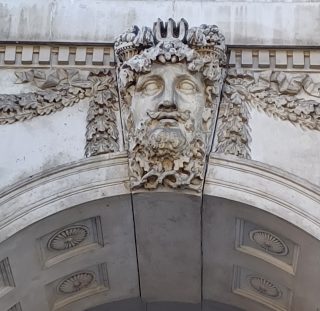
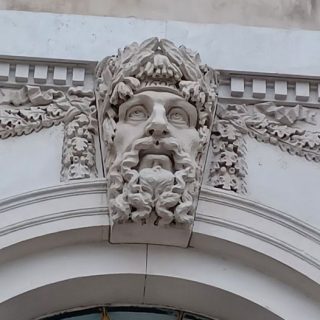
14 faces look out over Dublin City, their countenances ranging from pensive, to sorrowful, to jolly. These are the River God heads carved into the keystones of Dublin’s Custom House by Edward Smyth. They represent some of the major rivers of Ireland, and includes the Atlantic Ocean to signify Ireland’s wider trade. All of them have a story attached to them, many steeped in Celtic mythology.
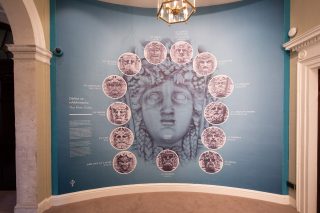
I have always had an interest in mythology, particularly the feminist readings of mythology and the role women play in this pseudo-history. I became fascinated by the stories connected to these Riverine faces, and even more interested by the fact that the stories attached to them, and the rivers they represent, were relating to women in our mythology. Yet Smyth designed all but one as male…
Upon researching some the myths behind Smyth’s River Gods, it became clear that most of the rivers, in Celtic mythology, are personified as goddesses, not gods, which raised the question as to why Smyth created 13 out of his 14 faces as men? There are unfortunately no sources to glean the thoughts of Smyth during his creation of the River Gods, but there is no denying that they are some of his best work; something which James Gandon (architect of the Custom House) was also aware of when he saw Smyth’s designs for the building’s statues.
Gandon had already hired an Italian man, Agostino Carlini, to design and create the majority of the statues on the Custom House. That was before Edward Smyth, an Irish sculptor hailing from Co. Meath, submitted his designs for the building. When he viewed Smyth’s designs, Gandon declared him equal to Michelangelo (a very high compliment indeed), gave Carlini his P45, if you will, and Smyth became the creator of nearly all of the statues you see on the building today.
Was Smyth aware of the mythological significance of the faces he created? Did he deliberately ignore the rivers’ female associations, or have no idea?
Some of these faces, and their stories, demonstrate a connection between women, water, and wisdom. This is tied to the tales of the fae folk, or the Tuatha de Danánn and their beliefs, and the goddesses they worshipped. While these mythological women are now hidden behind the male faces displayed on the Custom House, it is important to bring their stories back to the forefront and reveal how women, their association with water, and the search for wisdom all intertwine.
SINANN & BOAND
The one Riverine head out of the 14 on the Custom House that is represented as a woman depicts the River Liffey, or Anna Livia as she becomes known after James Joyce’s Finnegan’s Wake. She is overlooking the river above the front door of the Custom House on the south façade. However, the two main Riverine heads that are of particular interest regarding their mythology are The Shannon (which flows from Cavan to Kerry) and The Boyne (which flows through Meath), and touching briefly on The Lagan (which flows through Belfast). All three are represented as men, as gods, but their mythological stories are very much connected to women.
The stories connected to the Shannon and the Boyne are found in the Metrical Dindshenchas, which explains the mythological origins of the rivers. The Dindshenchas is an early Irish text which reveals the origin of place names, and means ‘lore of places’. Within it there are two poems each given to the women linked to the creation of the two rivers: Sinann and Boand. These poems are said to date back to around the 10th or 11th centuries, and the stories are very similar.
The poems are exceptionally long, so below are sections[1] from the poems relevant to the connection between women, water, and wisdom:
Sinann I:
In the still Land of Promise,
that no storm of bloodshed mars,
the deathless maid gained the fame that was her undoing,
the daughter of bright Luchar, whom I celebrate.
A well with flow unfailing
is by the edge of a chilly river
(as men celebrate its fame),
whence spring seven main streams.
Here thou findest the magic lore of Segais
with excellence, under the fresh spring:
over the well of the mighty waters
stands the poets’ music-haunted hazel.
The woman of Luchar of full chastity
followed the stream of Segais
till she reached the river’s brink
and met destruction and utter frustration.
There the comely lady was drowned
and perished under heavy injury;
though the woman of warlike ardour is dead,
her noble name clave to her river.
Sinann II:
The maiden, — fair was her form, —
came on a day to the river
and saw — it was no paltry matter —
the lovely mystic bubbles.
The maiden goes on a lamentable venture
after them into the green-flowing river:
she is drowned yonder through her venture;
so from her is Sinann named.
Boand I:
As thrice she walked round
about the well heedlessly,
three waves burst from it,
whence came the death of Boand.
They came each wave of them against a limb,
they disfigured the soft-blooming woman;
a wave against her foot, a wave against her perfect eye,
the third wave shatters one hand.
She rushed to the sea (it was better for her)
to escape her blemish,
so that none might see her mutilation;
on herself fell her reproach.
Every way the woman went
the cold white water followed
from the Sid to the sea (not weak it was),
so that thence it is called Boand.
Boand II:
Thither came by chance the Dagda
into the house of famous Elcmaire:
he fell to importuning the woman:
he brought her to the birth in a single day.
Boand went from the house in haste
to see if she could reach the well:
she was sure of hiding her guilt
if she could attain to bathe in it.
the strong fountain rose over her,
and drowned her finally.
[1] Should you wish to read the entirety of the poems: https://celt.ucc.ie/published/T106500D/index.html
though the woman of warlike ardour is dead,
her noble name clave to her river.
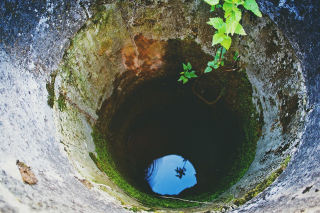
The two poems on Sinann describe a well (Connla’s Well), which is surrounded by nine hazel trees, these hazelnuts contain magic, so that when they drop into the water they create “mystic bubbles” in the stream of Segais, which flows from the well. Sinann follows the stream in search of the one gift she does not possess – imbas, or wisdom – and is subsequently drowned. The river that is created from her drowning is named after her – The Shannon. Sinann has now become the river.
When you delve into the words that are used to describe Sinann, the first poem focuses heavily on her virginal virtues: “The woman of Luchar of full chastity”/ “of the pure-white modest woman.” The second poem does the same, continuously referring to Sinann throughout as “maiden”, and noting her “fair form”. While the poems attempt to reduce Sinann to that of a pure, virginal maiden, they do tell us that she deliberately went to the well in search of knowledge: Sinann I says: “There lacks no desirable gift that I could not fancy as belonging to that noble lady save magic lore in its sequences/the deathless maid gained the fame that was her undoing.” While Sinann II says: “One night the maiden bethought her/that every sort of fame was at her command save the mystic art alone.” There is an autonomy here that Sinann possesses by choosing to seek out imbas forosna – the wisdom that illuminates.
Boand, like Sinann, also goes to a well in search of mystical knowledge. Poem I on Boand describes how the Segais well is guarded by her husband Nechtain, so that no-one but he and his cup-bearers can have access to the “mysterious evil” hidden within its waters. However, Boand challenges her husband’s rule and accesses the well; she is then attacked by the water, and drowned.
Poem II however is interesting in that it doesn’t describe Boand’s search for wisdom, but rather she goes to the well in the hopes of washing away her guilt for bearing the Dagda’s child, rather than her husband’s (which will be discussed further on). Boand appears bold and independent in her poems, challenging the water: “Hither came on a day white Boand (her noble pride uplifted her), to the well, without being thirsty to make trial of its power/As thrice she walked round about the well heedlessly.” Perhaps it is because Boand thought she could challenge the power of the water, that she is mutilated by it, rather than merely drowned, like Sinann. The river created from her drowning is now named after her – The Boyne.
We can see the surface story of how women, water, and wisdom connect: a woman goes to a well, to drink or bathe in its waters, in the hopes of gaining mystical knowledge. But how does it all intertwine on a deeper level? And why go to a well to receive wisdom?
WOMEN & WATER
To understand the deeper connection between women and water, we need to look at the Tuatha de Danánn and the Mother Goddess they worshipped. The Tuatha are a tribe of people living in Ireland around 1700BC, who have the ability to wield magic. It is this tribe who later become known as the Fae, or Faeries, as they reside underground in Síd, or faerie mounds (this is where the term banshee comes from, meaning woman from the mound). The Tuatha’s name literally translates to “Tribe of the Goddess Danu”, one of the Goddesses they worshipped.
Both Sinann and Boand are members of the Tuatha de Danánn, a people known for their wisdom, so it is perhaps for this reason that the two women go in search of the wisdom they feel they are owed as members of this tribe. But why go to the water in search of it?
To grasp the why, we need to look at their goddess, Danu. Danu is referred to as the Mother of the Gods, and has many gifts to her name. She is seen as the goddess of rivers, wisdom, and fertility. It is Danu who is responsible for the Tuatha receiving their renowned knowledge, passing her wisdom onto her people.
The various interpretations of the meaning behind Danu’s name helps solidify that connection between women, water, and wisdom, as words contain so much meaning.
In the Scythian language (which is a group of Eastern Iranian languages from the Classical – Late antique period) Danu is said to mean ‘river’. In Old Irish dán means ‘gift or skill’ – so in different languages, in different parts of the world Danu represents both water and wisdom. Her gift of wisdom is passed to her people, but also to her legitimate children, their names carrying the power of the mother: Écna means wisdom or enlightenment, and Érgna means understanding.
Danu is not only a wise-woman, but a powerful witch (not in the connotation as we understand witch today, but more like a druid). Sharon Paice MacLeod notes how many sources refer to the Tuatha goddess as a ‘bandruí or bantúathach’, which means a female druid, or witch.
Let’s say then that the well-water is connected to the goddess Danu, that it contains her wisdom, that it is imbued with powerful magic, thanks to her witchcraft. It makes sense then that Sinann and Boand would go to the water in search of magical wisdom – a gift which they wish to receive from their Mother Goddess.
But why then are they punished or drowned for their search? Danu is viewed as containing a duality within her, both as the nurturing, benevolent Mother Goddess, but also as the destructive Warrior Goddess. Archaeological findings often came across weapons and gold at the bottom of well or lake sites, signifying offerings to the gods. Neither Sinann nor Boand offered any gift or sacrifice to the goddess in return for imbas – folklore suggests that rivers demand a sacrifice – perhaps the goddess felt insulted that the women would take her gift without anything in return, and drowned them for their insolence.
However, it could also be argued Danu gave them the greatest gift of all – immortality. The benevolent side of Danu is shown in the tale attached to the River Erne, when Érne runs away in fear from the warrior Cruachu Olcai and is taken by the water in protection.
Interestingly, Sinann herself is already associated with water long before she becomes the river Shannon. Her grandfather is Manannán Mac Lir – the god of the sea. Her connections to water therefore are already solidified, and her fate, perhaps, pre-destined.
There is a further connection between women and water beyond the Tuatha de Danánn’s goddess. In the Dindshenchas Sinann I poem there is a line that says “Let us recount the entire journey whereon went Sinann of noble repute to Lind Mná Féile in the west”. The words to focus on here are “Lind Mná Féile”. In old Irish this translates to “Pool of the Generous Woman”. Therefore, the water that Sinann goes to in order to gain imbas has already been given a female personification. However, developing that link between women and water is the word “féile”. In old Irish it means something different to what it means to us As Gaeilge today. Today, it means festival, but in old Irish it has been found to refer to both male and female genitalia. Directly before the word is “mná”, meaning woman. We can therefore make the connection that “mná féile” is a reference to a woman’s genitals, further solidifying that association between women and water.
Given that both Boand and Sinann die upon arriving at the well, it signifies the idea of life and death. The Mother Goddess giving birth, but upon death the two girls return to the womb and are reborn as rivers themselves.
Boand’s story does the same thing, describing the Boyne as parts of Boand’s body after she becomes the river. She is called “the White Marrow” and “white-bellied Boand”, acknowledging how woman and water are one.
Her connections to water therefore are already solidified,
and her fate, perhaps, pre-destined.
WOMEN & WISDOM
We’ve already established the connection between women and wisdom in the form of the goddess Danu, but there are other representations of how the two link, mainly through the figure of Boand.
Claudius Ptolemy, a Greek astronomer and geographer, created a map of Ireland, in the 2nd century, on which the river Boyne is called Bouvinda. Again, this is where language is important because bó, in Irish, means cow. I don’t imagine Ptolemy was insulting Boand, but rather exalting her, because cows were sacred animals to the Celts. However, Vinda means wisdom, which means Boand herself, and the river she becomes, is wisdom personified.
Perhaps Boand is declared wise because she does not adhere to her husband Nechtain’s control, refusing to allow the well, and its knowledge, to be accessed by him alone.
In Sinann’s second poem she, or rather the river she becomes, is referred to as Sín Morainn, which means Morainn’s Collar. The story behind the collar is that whomever wears it is compelled to tell the truth. It links Sinann with truth-telling, a form of wisdom, to know and tell the truth of things.
Both poems on Boand make reference to an affair between her and a figure called the Dagda. The Dagda is one of the gods of the Tuatha de Danánn, said to be their chief or leader, and is well-known for his skill and wisdom. He also was in possession of a cauldron, meant to represent abundance and plenty. There are plenty of sources in Irish literature which associate cauldrons with wisdom; but a cauldron is also a vessel for containing water, and was sometimes given up as an offering to the gods. This is fitting given that Danu is associated with rivers, and The Dagda is Danu’s son. Boand gives birth to The Dagda’s son Oengus Óg, who becomes the god of love.
Oengus is often visualised with swans surrounding him. This is because he falls in love with Caer, a woman who takes the form of a swan, and who Oengus transforms into a swan for in order to spend his life with her.
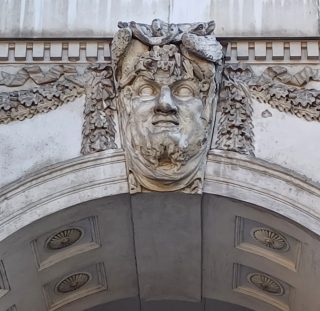
This connects with the story of The Children of Lir (which the River God Lagan represents – with the swan heads carved onto the face), where four children of the Tuatha de Danánn are cursed to live 900 years as swans by their stepmother. Due to the stories associated with swans in Celtic mythology, they are viewed as a respected animal in Ireland today.
However, swans are also viewed as having a link between this world and the Otherworld.
WISDOM & THE OTHERWORLD
In Nuala Ní Chonchuair’s poem “The White Mantle”, which is based on Caer, she describes her transition into a swan: “I seasonally adjust, slipping through the gap between this and the otherworld, where I wear a white mantle and I rush and slide on Loch Béal Dragan” Only when Caer is in swan form can she transfer between our world and the Otherworld, when she is one with the water. Perhaps it is for this very reason that the swans in the Children of Lir live for 900 years. Not because that was the curse put upon them, but because they lived as swans, connected to the water, which is connected to the Otherworld, a place between life and death. It is only when they leave the water and revert back to their human forms that the children die.
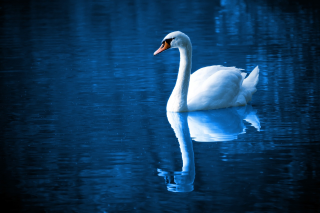
In Celtic mythology the Otherworld represents both the Faerie paradise realm and a spiritual realm for the dead. Either way you look at it, the Otherworld is representative of eternity because time works differently to reality – a couple of years in the Otherworld could equate to a day or two here. The Otherworld is viewed as the ultimate source of powerful knowledge – its access point? Under or across the water. It was seen as the living place of the deities; so if the Otherworld was the residing home of Danu, it is plausible that water would give access into the Otherworld and to Danu herself.
slipping through the gap between this and the otherworld
It makes sense then that if the Otherworld represents immortality and water is the access point, that Sinann and Boand live on in the water they were consumed by. It is not death for them, but a life in the Otherworld, and eternal access to the source of imbas forosna. Or rather they become imbas forosna, as they are now the access point to the Otherworld.
The Otherworld, however, is only accessible via specific points.
Sinann’s story notes how hazelnut trees surround Connla’s well, dropping their produce into the water. Hazelnuts are seen as a product associated with the Otherworld. Perhaps it is these that open the gateway through the water from our world into the Otherworld of Danu and other deities.
The stream of Segais is the water in which both Sinann and Boand attempt to receive imbas. Segais is specifically noted as being connected with wisdom and the Otherworld. And it is said that access to ‘immus na Segsa’, the great knowledge of Segais can be found there.
Within Celtic mythology there is an innate connection with water and its representation of wisdom through the goddess Danu, and the depiction of water as analogous to that of women’s bodies – as seen particularly in the stories of Sinann and Boand.
These mythological stories, although not reality, have bled into religious traditions, such as the worshipping at the Trinity Well on Pentecost Sunday – the well being the source of the River Boyne. However, female deities have been worshipped for their wisdom long before the male-centric focus of modern religions.
The connection between women, water and wisdom is an intrinsic one, one that seeps from our mythologies into our realities, and is inherently linked to the depiction of the Mother Goddess and her knowledge. But that’s not hard to believe, as the saying goes: “Mother knows best”.
Mother Knows Best
Sources:
Arbuthnot, Sharon, 2021. The Medieval Irish Vocabulary of Sex and Reproduction: Insights from the Trotula and Other Medieval Texts. Kelten.vanhamel.nl.
Beck, Noémie. The River-Goddess in Celtic Traditions: Mother, Healer and Wisdom Purveyor in Mélanges en l’honneur de Pierre-Yves Lambert, 2015.
Carey, John, 1987. Time, Space, and the Otherworld. Jstor.
E.K., 1919. The Boyne and What it Stands for. Jstor.
Hopkins, Pamela, 1992. The Symbology of Water in Irish Pseudo-History. Jstor.
Hore, Herbert & Mac Ritchie, David, 1895. Origin of the Irish Superstitions Regarding Banshees and Fairies. Jstor.
Mac Cana, Proinsias, 1980. Women in Irish Mythology. Jstor.
MacLeod, Sharon Paice, 2006/2007. A Confluence of Wisdom: The Symbolism of Wells, Whirlpools, Waterfalls and Rivers in Early Celtic Sources. Jstor.
MacLeod, Sharon Paice, 1998/1999. Mater Deorum Hibernensium: Identity and Cross-Correlation in Early Irish Mythology. Jstor.
MacLeod, Sharon Paice, 2003. Oenach Aimsire na mBan: Early Irish Seasonal Celebrations, Gender Roles and Mythological Cycles. Jstor.
Ní Chonchúir, Nuala. The White Mantle.
Oxfordreference.com
Selling, Kim, 1998. The Locus of the Sacred in the Celtic Otherworld. Sydney Open Journals.
Spaan, David B., 1965. The Place of Manannan Mac Lir in Irish Mythology. Jstor.
Storyarchaeology.com
The Metrical Dindshenchas. Celt.ucc.ie
Williams, Mark, 2016. Ireland’s Immortals: A History of the Gods of Irish Myth. Princeton University Press, New Jersey.