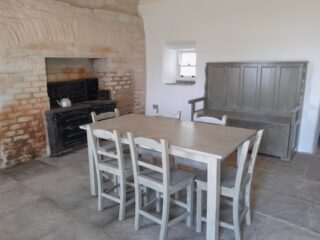
The furniture in the restored cottages is based on the layout and type of furniture in documentation about Scattery Island and drawings and photographs from archive sources respectively. Don Scanlan’s book about Scattery Island provided details of the type and layout of furniture in the cottages including a kitchen table and set of chairs, a dresser against the internal wall opposite the main fireplace and a settle against the rear wall. Drawings of cottages around Ireland in the 1940s from the Irish Folklife Collection in the National Museum of Ireland included floor plans, which also provided information showing typical furniture layouts of similar direct-entry cottages around Ireland.
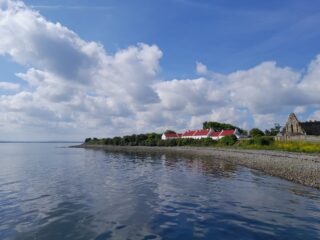
All of the furniture details in the houses are based on details from drawings in the Irish Folklife Collection in the National Museum of Ireland, furniture from Clare and the surrounding counties, furniture in publications and furniture from the Museum of Country Life in Castlebar.
The furniture throughout ‘The Street’ consists of replica furniture made in White Deal by OPW Carpenters in Athenry with a set of kitchen chairs and children’s chairs from local suppliers. All of the dressers, settles, benches and a set of kitchen chairs were made by OPW Carpenters and apprentices. Due to the exposed location of the buildings on the island, and in order to prevent damage from dampness to original furniture, OPW Carpenters made replica furniture. The replica furniture also allows visitors to sit down on a guided tour or self-guided tour.
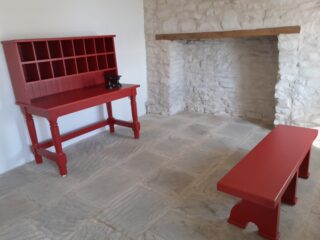
Local residents’ recollections of the Post Office at the northern end of ‘The Street’ have indicated that the layout was not based on a typical Post Office layout. The Post Office desk is based on furniture from a post office in a similar type of cottage in the Ulster American Folk Park in Omagh, with individual compartments for each house.
McMahon’s House at the centre of ‘The Street’ contains a settle based on the settle in the Loop Head Farmhouse in Bunratty Folk Park and a dresser based on an example from the Irish Folklife Collection with inset doors and drawers. Brennan’s House at the southern end of ‘The Street’ contains a low settle based on an example from the Irish Folklife Collection and a dresser based on a dresser from Co. Clare with inset doors and partially overlaid drawers. The low settle allows uninterrupted light to enter the house through the rear window, a feature on many of the Scattery houses.
The details vary between different items of each type of furniture, all of which are based on details in drawings and photographs of original furniture. Typical details vary and include tongue-and-groove boards to stop-chamfers and raised panels on settles and dressers. Details also include corbels, brackets, simple plain moulded cornices and simple plain moulded skirting boards on dressers. Brennan’s house and McMahon’s house contain different tables and chairs based on furniture from Clare and the neighbouring counties.
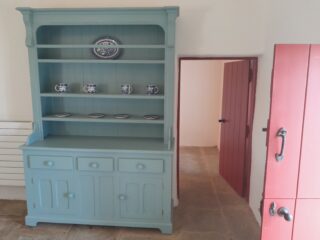
In order to mitigate the impact of the exposed location of the island on the furniture and to protect the furniture from the effects of dampness, the dressers and settles were raised slightly off the ground. Details were based on the sledge feet on traditional vernacular furniture, a detail also used to protect the base of furniture against water damage and dampness.
The furniture was painted in different colours based on images of furniture in publications by Claudia Kinmonth and furniture from the Museum of Country Life in Castlebar. Colours vary from house to house and include red, blue and grey. All furniture was painted throughout, in order to protect it.
Similar typical vernacular details are used for other features in the restored houses, all of which will be made by OPW Carpenters. The new desk in the visitor centre is based on similar details to the houses with simple tongue-and-groove boards and simple plain moulded skirting boards. The electrical board in each house will be enclosed by a press made of tongue-and-groove boards based on fireside presses in traditional cottages.
It is proposed to add to the furniture over time. OPW carpenters will make additional items of furniture including additional presses and bedroom furniture, all based on traditional vernacular furniture including further local examples.
Acknowledgements:
Terri Sweeney Meade, APA; Michèle O’Dea, Senior Architect; Frank Geraghty, District Works Manager; Michael Heraghty, Foreman; Tom Blunnie, General Operative/Skipper; Declan Furey, Carpenter; Kevin Skehill, Carpenter; Michael Cassidy, Apprentice Carpenter; National Museum of Ireland